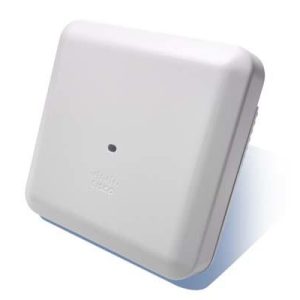
The Aironet 1850 Series extends support to a new generation of Wi-Fi clients, such as smartphones, tablets, and high-performance laptops that have integrated 802.11ac Wave 1 or Wave 2 support. And optimizes support for legacy clients. The onboard controller supports up to 25 Access Points, and 500 concurrent clients.
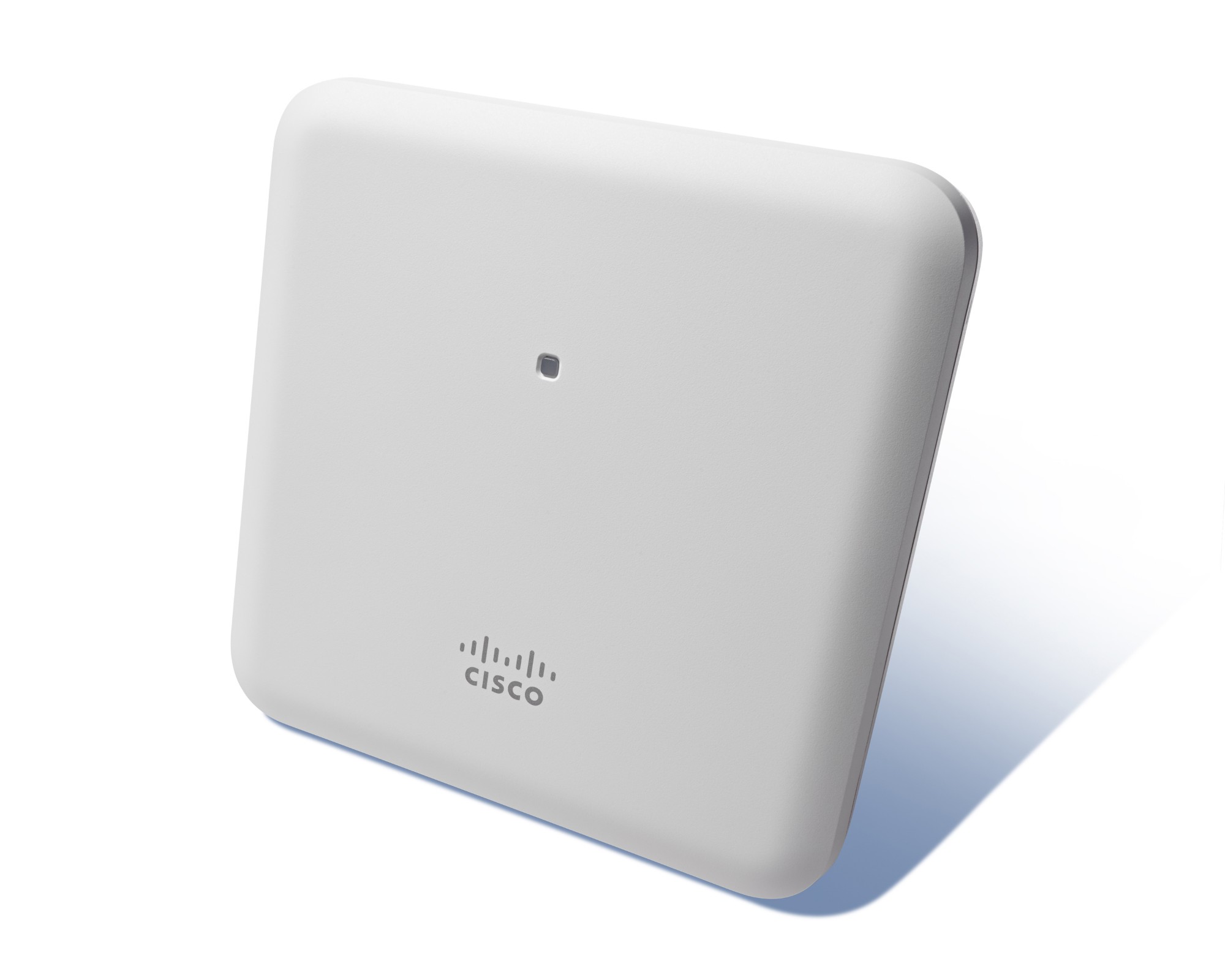
Cisco 1850 – Wireless Dual Band 802.11AC Access Point. Ethernet LAN data rates: 10,100,1000 Mbit/s, Frequency band: 2.4 – 5 GHz, Networking standards: IEEE 802.11a, IEEE 802.11ac, IEEE 802.11b, IEEE 802.11d, IEEE 802.11g, IEEE 802.11h, IEEE 802.11i,…. Security algorithms: WPA, WPA2. WAN connection: Ethernet (RJ-45). AC input voltage: 100 – 240 V, AC input frequency: 50 – 60 Hz, Output voltage: 57 V. Placement: Ceiling, Table, Wall, Product colour: White
The 1850 series provides the necessary foundation for enterprise and service provider networks to stay ahead of the performance, bandwidth expectations and needs of their wireless users. With a data rate of up to 1.7 Gbps on the 5-GHz radio, more than triple the rates offered by today’s high-end 802.11n access points. It also enables a total aggregate dual-radio data rate of 2.0 Gbps, due to its convenience, wireless access is increasingly the preferred form of network connectivity for corporate users. Along with this shift, there is an expectation that wireless should not slow down users’ day-to-day work, but should enable a high-performance experience while allowing users to move freely.
– IEEE 802.11ac Wave 2
– Dual Band (2.4Ghz & 5Ghz)
– PoE for simplifed integration
– Throughput 1.7-Gbps
Full specifications for this model are listed below.
| Receiver sensitivity | 802.11b (CCK) 802.11g (non HT20) 802.11a (non HT20) 2.4 GHz 5 GHz |
|---|---|
| Product Condition | New Retail |
| Flash memory | 256 MB |
| Internal memory | 1024 MB |
| USB 2.0 ports quantity | 1 |
| WAN connection | Ethernet (RJ-45) |
| pa_i_ethernetlanrj4_2312_1 | 2 |
| Weight | 1.41 kg |
| Power consumption (typical) | 20.9 W |
| Operating altitude | 0 – 3000 m |
| Operating relative humidity (H-H) | 10 – 90% |
| Operating temperature (T-T) | 0 – 50 °C |
| Storage temperature (T-T) | -30 – 70 °C |
| Ethernet LAN data rates | 10,100,1000 Mbit/s |
| Security algorithms | WPA, WPA2 |
| Channels quantity | 25 channels |
| Frequency band | 2.4 – 5 GHz |
| Antenna gain level (max) | 5 dBi |
| Web-based management | Yes |
| Non-operating altitude | 0 – 4572 m |
| Height | 50.8 mm |
| Networking standards | IEEE 802.11a, IEEE 802.11ac, IEEE 802.11b, IEEE 802.11d, IEEE 802.11g, IEEE 802.11h, IEEE 802.11i, IEEE 802.11n, IEEE 802.1x, IEEE 802.3af, IEEE 802.3at |
| Antennas quantity | 4 |
| Depth | 210.8 mm |
| Width | 210.8 mm |
| Product colour | White |
| Output voltage | 57 V |
| Placement | Ceiling, Table, Wall |
| Wi-Fi Multimedia (WMM)/(WME) | Yes |
| Antenna direction type | Omni-directional |
| Antenna design | Integrated antenna |
| AC input voltage | 100 – 240 V |
| AC input frequency | 50 – 60 Hz |
| Harmonized System (HS) code | 85176990 |
Our specialists are here to help assess compatibility, compare suitable alternatives, or talk through your configuration needs before committing to a solution.
Contact us today for a no-obligation chat.
Below you’ll find alternative models, suitable software and services that pair with this solution – helping you to avoid compatibility issues, reduce support overhead and deploy with confidence.
Not all deployments fit standard configurations. If you’re weighing up options or want a second opinion on your setup, our team is here to help with honest, straightforward advice backed by decades of vendor knowledge.